WHAT IS UREA ?
- Urea is a Carbonic Acid diamide and is the solid Nitrogen fertiliser with the highest Nitrogen UF, 46% in ureic form.
It has different commercial names: carbamide, carbonyl diamide or Carbamic Acid.
Its chemical formula is CO (NH2)2. - Urea, in its initial acidic form, is not assimilated by the plant until its transformation into AMONIACAL AND THEN INTO NITRIC FORM. These transformation steps depend on the present atmospheric situation, humidity and temperature, as well as the Organic Matter (OM) existing in the soil.
All these factors activate the enzymatic hydrolysis of urease within a short period of days. - The nitrification process will be more or less accelerated depending on the fauna, i.e. soil micro-organism and PH. This entire process ends when NITROGEN turns into its NITRICA form, where it is absorbed.
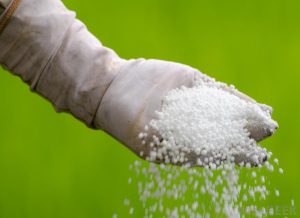
- The presentation format is in solid white crystals of a spherical-granular shape, pearled, or diluted in liquid form, depending on the application and on the current needs of the crop.
It is also used for manufacturing as a raw material in BLENDING along with other raw materials (Ammonium Sulphate, DAP, etc.). - It is the most widely used fertiliser in agriculture.
- It provides Nitrogen, which is essential for the plant.
- It provides 46 UF.
- N is the necessary pathway for chlorophyll synthesis.
- Urea, with its contribution of N, is one of the components providing the plant with vitamins.
- Nitrogen is primordial. It is a component of the amino acids which means it is responsible for the increase of protein in plants, leading to the correct development of leaves, shoots and stems.
- In cereal crops it is the first factor that determines the amount of protein in grain formation.
- It is hygroscopic, which means it has the capacity to absorb water from the atmosphere.
Urea is:
- Non-toxic
- Non-carcinogenic
- Non-flammable